This is part 2 of my series on the history of computer games. Start with part 1, which covers everything up to 1980.
In part 1 we went from oscilloscopes to Pac-Man. This time we cover the first half of the 80s, the years when computers moved into ordinary homes, whole genres were born, and a 17-year-old could write a hit game in his bedroom. It's also where my own memories start. I turned four just before Christmas 1980, so for me these years are a mix of things I remember and things I only understood much later.
From 1985 onward I'll go year by year. But first, the years that set everything up.
My first games
My first gaming memories are from my grandfather's home. Under his TV there was a flat box with a round switch that picked between six games. I remember two-player Pong, squash, and the shooting games where you aimed a light gun at a square on the screen. As I wrote in part 1, that box was almost certainly built around the AY-3-8500 "Pong on a chip". By the early 80s it was already old technology, but to a small kid it was magic.
I remember people playing it at a family gathering, and I played it myself at some point too. I obviously don't know exactly when they got it.
I had played arcade games here and there before, but my first real arcade memories are from a hotel in Cyprus, around 1984 or 1985. They had a Space Invaders machine, and I played it a lot. By then the game was already six or seven years old, but that didn't matter one bit.
Donkey Kong and the handheld boom
In July 1981, Nintendo released Donkey Kong in the arcades. It was designed by Shigeru Miyamoto, and its hero was a carpenter called Jumpman. Nintendo of America later renamed him Mario, reportedly after the landlord of their office. Donkey Kong is often credited with pioneering the platform game before anyone called it that, and it used short animated scenes to tell a complete little story, which was new at the time. It was also a huge hit: around $280 million in US arcade cabinet sales by 1982.
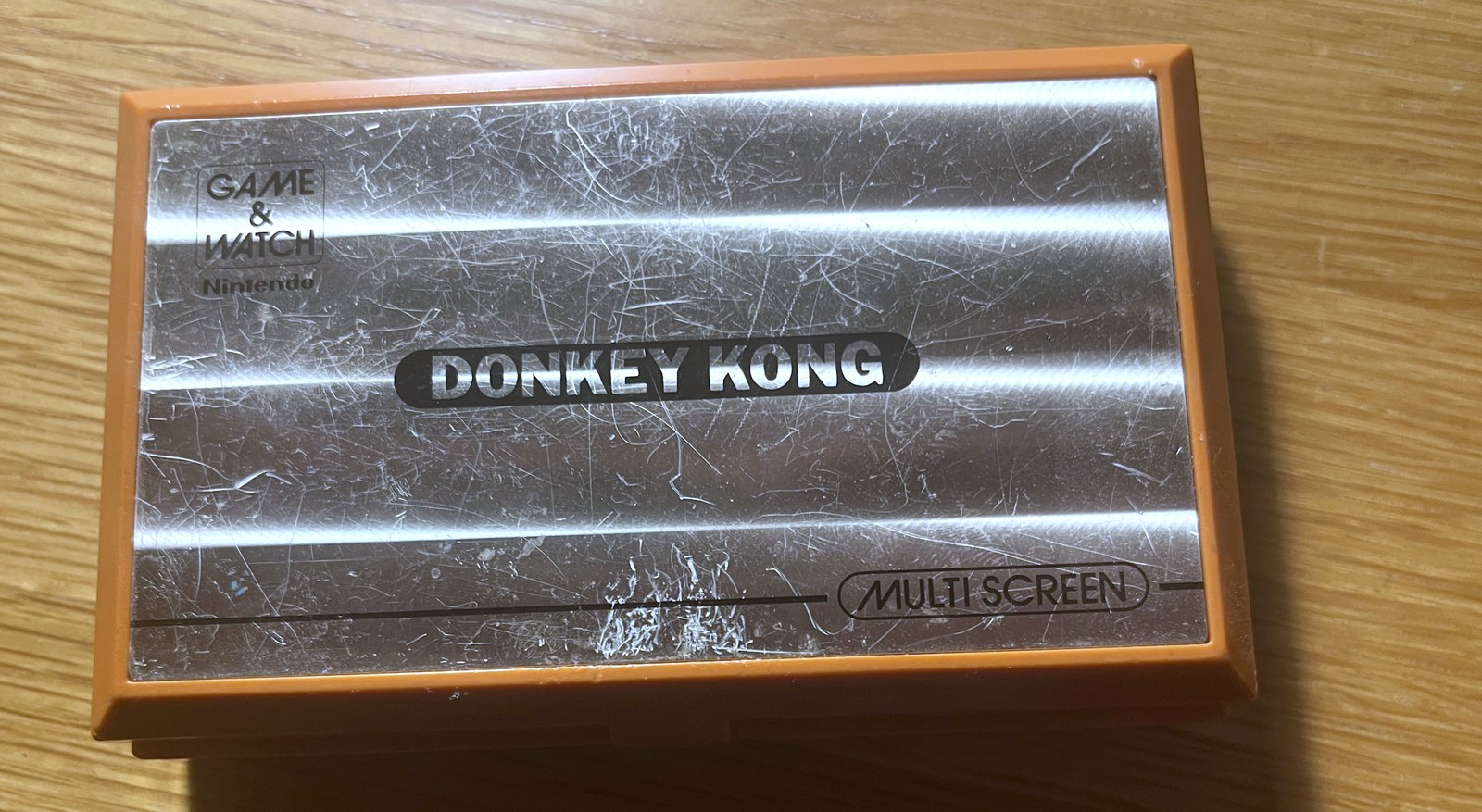
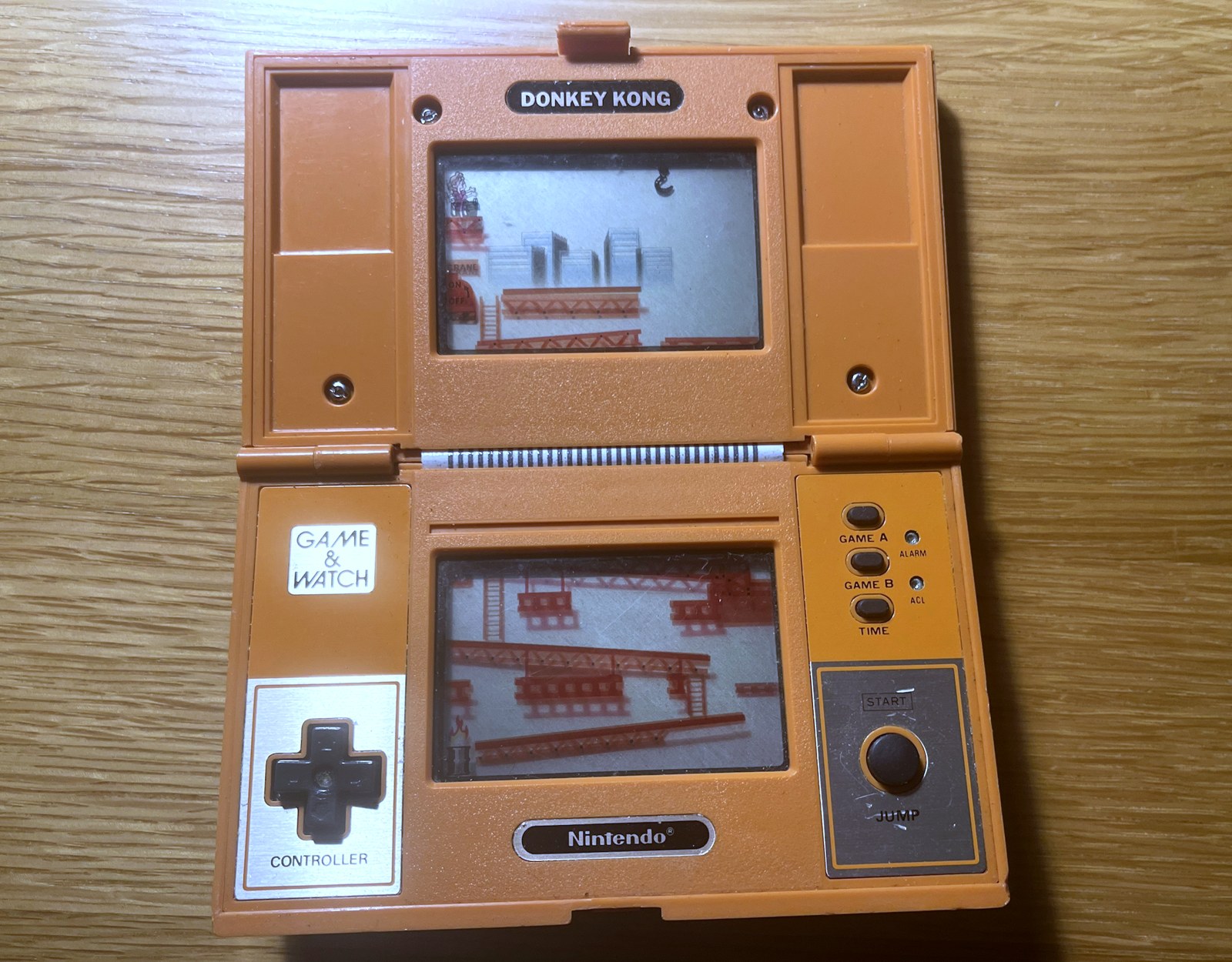
Arcade games were also shrinking into your pocket. Nintendo's Game & Watch line got its two-screen Multi Screen series in 1982, and on June 3, 1982, the Multi Screen Donkey Kong came out. It was the first piece of video game hardware with the cross-shaped directional pad, the D-pad that Nintendo has used on almost every system since. Game & Watch sold 43.4 million units in total, and Sweden was a surprisingly big part of that. Nintendo's Swedish distributor Bergsala, run by Owe Bergsten, had sold close to 1.7 million of them by 1983, in a country of only 8.3 million people. That early success is also a big part of why Nintendo became so strong in the Nordic countries later on.
I still have my orange Donkey Kong Game & Watch. It's scratched and worn after years of use, but it's still here. I don't remember exactly when I bought it. The big brother of a friend had one, and I must have tried it at some point and wanted one of my own. I do remember where, though. I think I paid 219 kronor for it at a local watch shop that still exists today.
I played it a lot, especially on car trips. It made those long drives go much quicker back then.
Not everything was LCD. Tomy's Puckman from 1981 used a glowing VFD screen, the same kind of bright blue-green display you'd find on a clock radio. It was sold as Puckman in Japan, Munchman in the UK and Pac Man in North America, and Tomy reportedly sold at least 700,000 of them. I got mine around 1984. It was a round, yellow thing that looked like a flying saucer, and at some point it disappeared. I really wish I still had it.
Computers for the masses
Commodore's VIC-20 came out in Japan in 1980, as the VIC-1001, and in the rest of the world in 1981. It became the first computer of any kind to sell one million units. It launched in Sweden in November 1981 for 2,499 kronor. Commodore's boss Jack Tramiel had a simple idea: computers should be for the masses, not the classes.
The machine that really proved him right was the Commodore 64. It was released in August 1982 for $595, and within two months Commodore had cut the price by $200. By June 1983 it was down to $300, and some stores sold it for $199. It had 64 KB of memory and the SID sound chip, a real three-channel synthesizer that made C64 music sound like nothing else at the time. Estimates of total sales range from 12.5 to 17 million, and Guinness lists it as the best-selling desktop computer model of all time. In Sweden it quickly took around 40 percent of the market in its first years, according to Internetmuseum, and plenty of later Swedish game developers started out on Commodore machines. Minecraft's creator Markus "Notch" Persson, for one, learned on his father's Commodore 128, just like I did on mine.
In the UK, Sinclair launched the ZX Spectrum on April 23, 1982. It cost £125 for the 16 KB model and £175 for 48 KB. It had rubber keys and a famous limitation called colour clash, where every 8 by 8 pixel block could only use two colours, so moving sprites often changed colour as they passed over things. None of that mattered. It sold over 5 million units and became the machine that built the British games industry.
The Spectrum was also the first home computer I got to use. A friend of mine had a 48K, and we played on it at his place in the mid 80s, hooked up to a tiny TV of maybe six to eight inches. That was small even back then. The games I remember are Harrier Attack, Bruce Lee and Bomb Jack.
The birth of the computer RPG
In part 1, I left Richard Garriott with a hit game in a Ziploc bag and his old nickname, Lord British, on the box. In June 1981, California Pacific released Ultima, often called the first open-world computer RPG. You explored a top-down world, went down into first-person dungeons and, for some reason, ended up flying a spaceship. Ultima II followed on August 24, 1982, published by Sierra, and it started the series' tradition of a cloth map in the box. After a fight with Sierra over royalties, Garriott started his own company. Origin Systems was founded on March 3, 1983, by Richard, his brother Robert, their father Owen and programmer Chuck Bueche, working out of the family garage. Their first release was Ultima III: Exodus the same year.
Just a few months after the first Ultima, in September 1981, Sir-Tech released Wizardry: Proving Grounds of the Mad Overlord for the Apple II. You built a party of up to six adventurers and took them down ten levels of first-person dungeon. If that sounds like Oubliette from part 1, you're paying attention. Wizardry sold 24,000 copies by June 1982 and around 200,000 within three years, more than the first Ultima. Along with Ultima, it inspired Japanese series like Dragon Quest and Final Fantasy.
Two series, launched the same year, that between them shaped almost every RPG that followed.
Words and pictures
Remember Zork from part 1? The MIT students behind it had founded Infocom in 1979. Zork I was first released in 1980 through Personal Software, and after that Infocom published its own games. Their secret weapon was the Z-machine, a virtual machine that let them release the same game on more than 20 different computers. Their boxes came with "feelies": maps, props and odd little extras that doubled as copy protection. Through these years they released games like Deadline (1982), Planetfall (1983) and The Hitchhiker's Guide to the Galaxy (1984). By 1986 the Zork trilogy alone had sold 680,000 copies.
Meanwhile, Roberta Williams at Sierra wanted pictures that moved. In May 1984, King's Quest was released for IBM's new PCjr. IBM put $700,000 into the project, making it the most expensive game Sierra had ever made. Instead of reading descriptions or looking at still pictures, you walked your character around an animated, graphical world. Adventure games would never be the same. It's also credited with saving Sierra after the 1983 crash.
The crash I never noticed
In the US, 1983 was a disaster. Too many consoles, too many bad games and far too much stock led to what we now call the video game crash. Home video game revenue fell by about 97 percent, to around $100 million by 1985. Atari famously buried around 728,000 unsold cartridges, including E.T. and Pac-Man, in a landfill in New Mexico. When part of the site was dug up in 2014, the burial was confirmed, and the former Atari manager who had been in charge of it put the number at 728,000.
Home computers played a part too. When a Commodore 64 cost about the same as a console, a lot of people asked themselves why they should buy something that only played games.
In Europe, the story was completely different. In the early 80s, home computers dominated here, and the American consoles never had the same grip on the market. In some countries, like the UK, consoles didn't really take off until the early 90s. In the UK, the number of companies selling games on cassette went from 95 to more than 450 during 1983. The Nordic countries were different again. When the NES arrived in 1986, it became huge here, but that's a story for the year-by-year posts. So while the American console market collapsed, we were busy loading games from tape. As a kid in Sweden, I had no idea anything had crashed at all.
Bedroom coders
This is the part of the story I love the most.
Matthew Smith was 17 when he wrote Manic Miner for the ZX Spectrum in 1983. It took him eight weeks. It had twenty caverns, pixel-perfect jumps and in-game music, which was rare at the time: "In the Hall of the Mountain King" by Edvard Grieg. Its sequel, Jet Set Willy, came out in 1984. By one estimate, somewhere between 10,000 and 50,000 young people in the UK were making games at home in those years. Most of them never got anywhere, but some went on to build studios.
Two brothers, Chris and Tim Stamper, ran a small company called Ultimate Play the Game. In November 1984 they released Knight Lore, which used a technique they called Filmation to draw isometric 3D rooms where objects could pass in front of and behind each other. Edge magazine later called it "the single greatest advance in the history of video games". The Stampers later founded Rare, but that's a story for much later.
In the US, the business side was growing up too. Trip Hawkins, who had worked at Apple, founded Electronic Arts on May 27, 1982. EA called its developers "artists", gave them photo credits in magazine ads and sold games in square boxes that looked like record sleeves. Its first games in 1983 included M.U.L.E. and Pinball Construction Set.
Another company started the same year with a much better origin story. Sid Meier and Bill Stealey were playing the arcade game Red Baron in Las Vegas, and Meier kept winning. He explained that he had worked out how the game's code behaved and claimed he could write a better game for a home computer in a week. Stealey said he'd sell it if he did. It took two months, not one week, but the result was MicroProse, founded in 1982. Its first games were flight combat games for Atari's 8-bit computers, like Hellcat Ace in 1982, and then F-15 Strike Eagle, which went on to sell more than a million copies. Sid Meier would go on to become one of the biggest names in computer gaming, but his best-known games come later in this series.
Elite
If one game sums up what these years made possible, it's Elite.
It was written by David Braben and Ian Bell, who met as students at Jesus College, Cambridge, and it was released for the BBC Micro on September 20, 1984. You started with a small ship and a few credits and could do whatever you wanted: trade, mine asteroids, hunt bounties or become a pirate, all while working your way up to the combat rating "Elite". It was one of the first home computer games with wireframe 3D graphics that hid the lines you shouldn't see, and it had eight galaxies with 256 planets each. None of those planets were stored in the game. They were all generated from a single seed number run through a fixed algorithm, which is how Braben and Bell fit a whole universe into a home computer of the time.
The BBC Micro version alone sold 107,898 copies, and estimates for all versions together range from 600,000 to around a million. Almost every open-world space game since, all the way up to Elite Dangerous, owes something to it.
Meanwhile, in Japan and Moscow
On July 15, 1983, in the middle of the American crash, Nintendo released the Family Computer, or Famicom, in Japan for 14,800 yen. Its launch games were ports of Donkey Kong, Donkey Kong Jr. and Popeye. In Japan the crash barely registered, and the Famicom became a huge success. The rest of the world would get it a few years later under a different name.
And in Moscow, a researcher named Alexey Pajitnov wrote a little puzzle game on an Elektronika 60 computer at a computing centre of the Soviet Academy of Sciences. Most sources date it to June 1984, though some say 1985. It spread on floppy disks around Moscow and later around the world. It was called Tetris.
Meanwhile, in Swedish schools
The Swedish ABC 80 from part 1 had become a common computer in Swedish schools, but by 1980 it was already seen as becoming obsolete. The answer was the Compis, a Swedish educational computer introduced in 1984, built around an Intel 80186. It was controversial from the start, and once the world moved to IBM PC compatibles, it was left behind. It was officially discontinued in 1988, but many schools kept using them well into the 90s. I used one myself around 1989 or 1990, in an introduction to computers at school. It was very limited, and even then it already felt old.
Where we are in 1984
By the end of 1984, the home computer had won in Europe, the computer RPG and the graphical adventure had been born, and kids in bedrooms were writing games that sold in the hundreds of thousands. In the US, the console business was in ruins, and in Japan, Nintendo was quietly getting ready to fix it.
From here I'll go year by year. 1985 is a big one: the Amiga and the Atari ST arrive, the C64 is at its peak, and Nintendo gets ready to bring the Famicom to the West as the NES. The NES reached Sweden on September 1, 1986, and I got to play it before I had a computer of my own. That came at Christmas 1987: a Commodore 128, the machine where I also wrote my first code. We'll get there.
Sources
- Donkey Kong, 1981 video game (Wikipedia)
- Game & Watch (Wikipedia)
- Donkey Kong, Game & Watch (Super Mario Wiki)
- One bullish Swede and some little white lies helped carve Nintendo's place in the West (Nintendo Wire)
- Så tog Owe från Kungsbacka Nintendo till Sverige (Kungsbacka-Posten)
- Pac-Man, Tomy LSI Game (Pac-Man Wiki)
- VIC-20 (Wikipedia)
- Historien om VIC-20 (Svenska Commodoreklubben)
- Commodore 64 (Wikipedia)
- Commodore 64 gör svenskarna till ett datorspelande folk (Internetmuseum)
- Markus Persson (Wikipedia)
- ZX Spectrum (Wikipedia)
- Ultima I: The First Age of Darkness (Wikipedia)
- Ultima II: The Revenge of the Enchantress (Wikipedia)
- Origin Systems (Wikipedia)
- Wizardry: Proving Grounds of the Mad Overlord (Wikipedia)
- Infocom (Wikipedia)
- King's Quest I (Wikipedia)
- Video game crash of 1983 (Wikipedia)
- Atari video game burial (Wikipedia)
- Manic Miner (Wikipedia)
- Matthew Smith, games programmer (Wikipedia)
- Knight Lore (Wikipedia)
- Electronic Arts (Wikipedia)
- MicroProse (Wikipedia)
- F-15 Strike Eagle (Wikipedia)
- Elite, video game (Wikipedia)
- Nintendo Entertainment System (Wikipedia)
- Tetris (Wikipedia)
- Compis (Wikipedia)