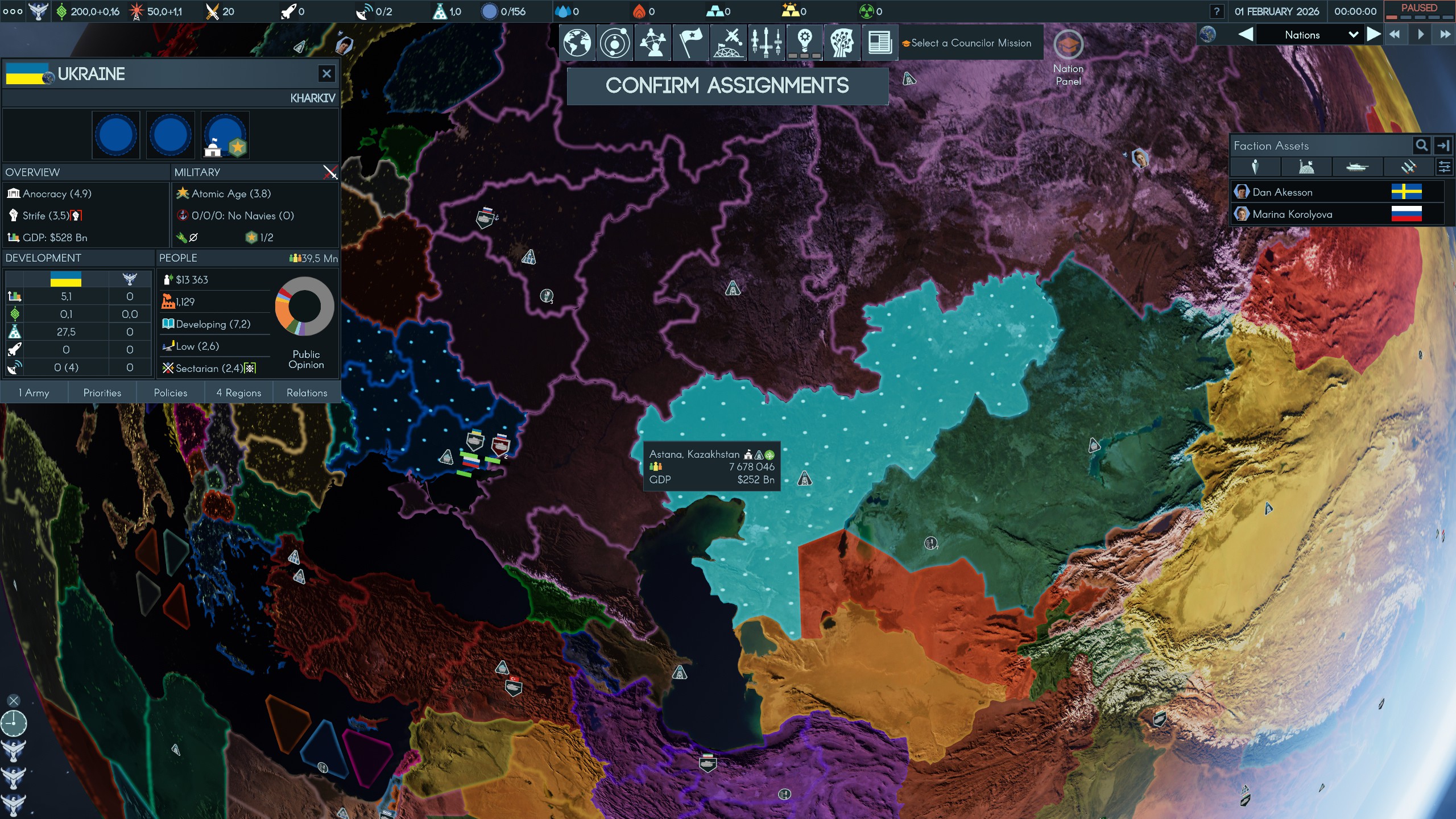
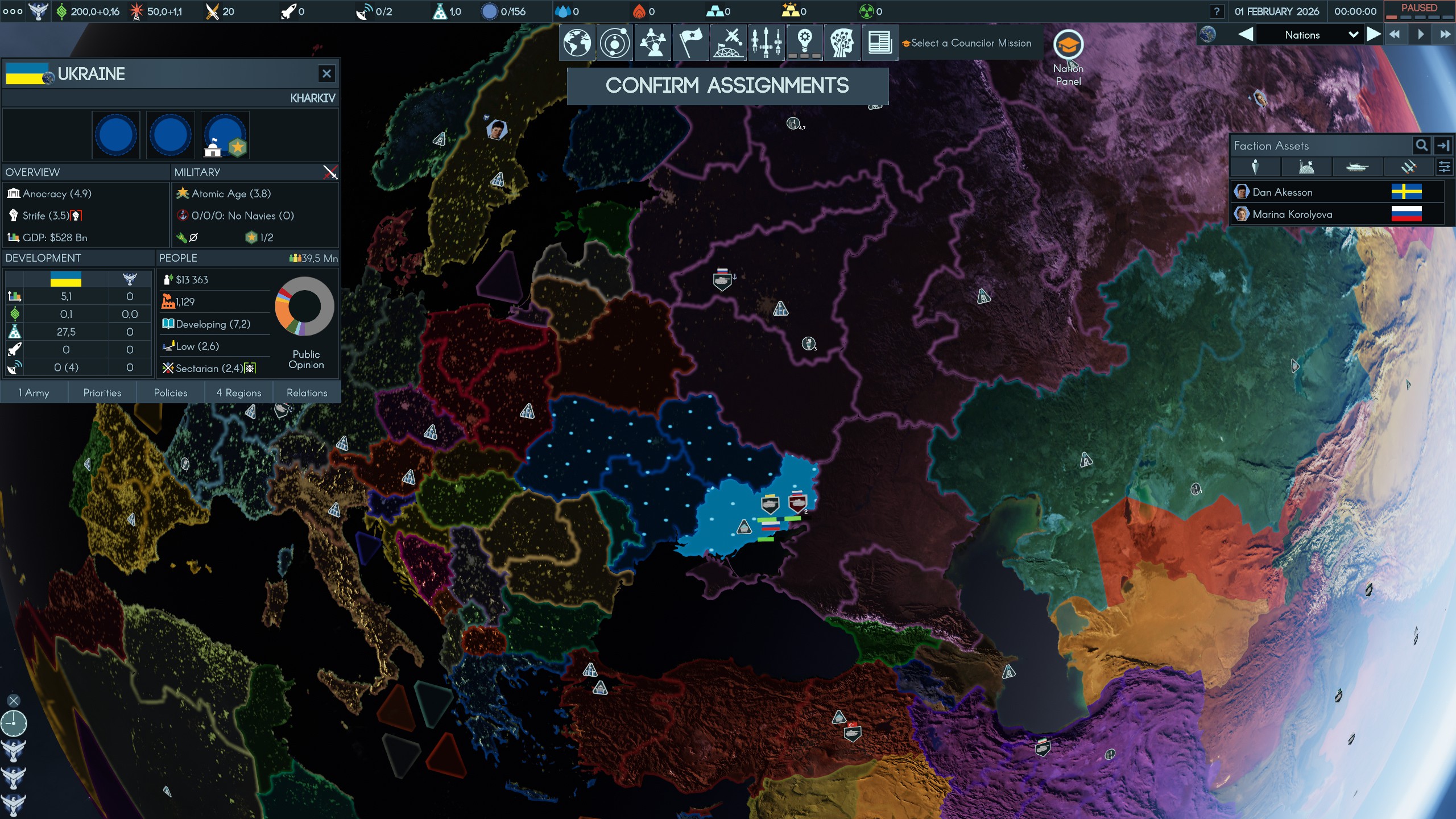
Terra Invicta is an indie grand strategy game from the developers of the Long War mod for XCOM 2. In recent years I've been playing a lot of indie games, since they tend to be more interesting. In Terra Invicta you take control of one of several human factions struggling for control over earth and space while dealing with an alien threat. The game starts in 2022, 2026 or 2070. If you start in either 2022 or 2026 you'll recognize some of the real world situation right away (there's a war going on between Russia and Ukraine for example). I've spent most of my time in this game while it was in early access, so things may have changed after release, and I'll update this review once I have time to play it more.
This is one of the most ambitious games I've ever played. It's trying to do a lot of things. Every region has GDP and a lot of the geopolitics are simulated. Also, a lot, if not most of the solar system is simulated. This is hard sci-fi with a lot of space physics simulated from my understanding. You could argue that this is several games baked into one. First of all you have the game on earth, where factions are struggling to gain control over nations, once you get into space, you have to manage space stations and fight space battles against aliens and possibly other factions.
Gameplay Overview
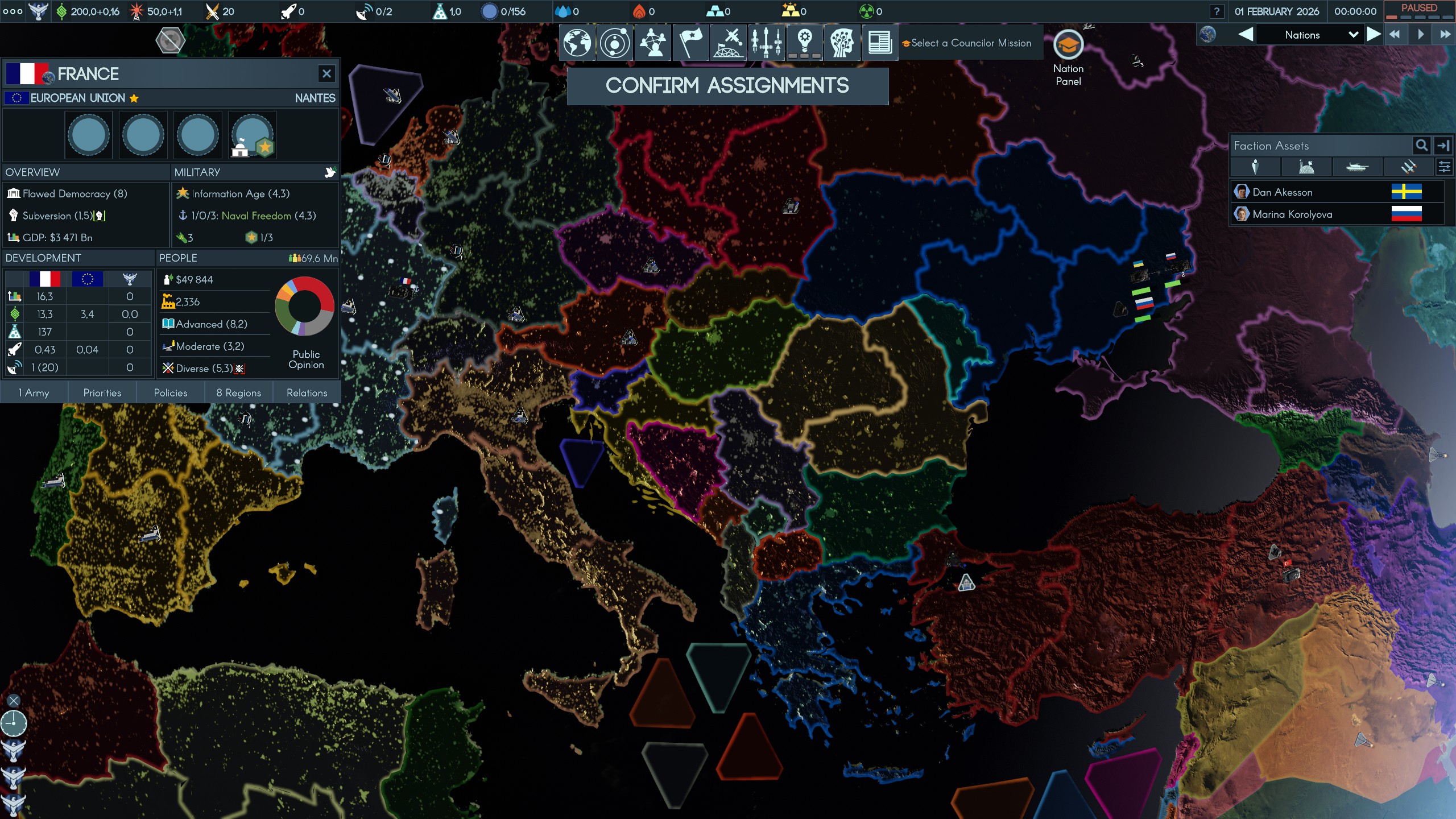
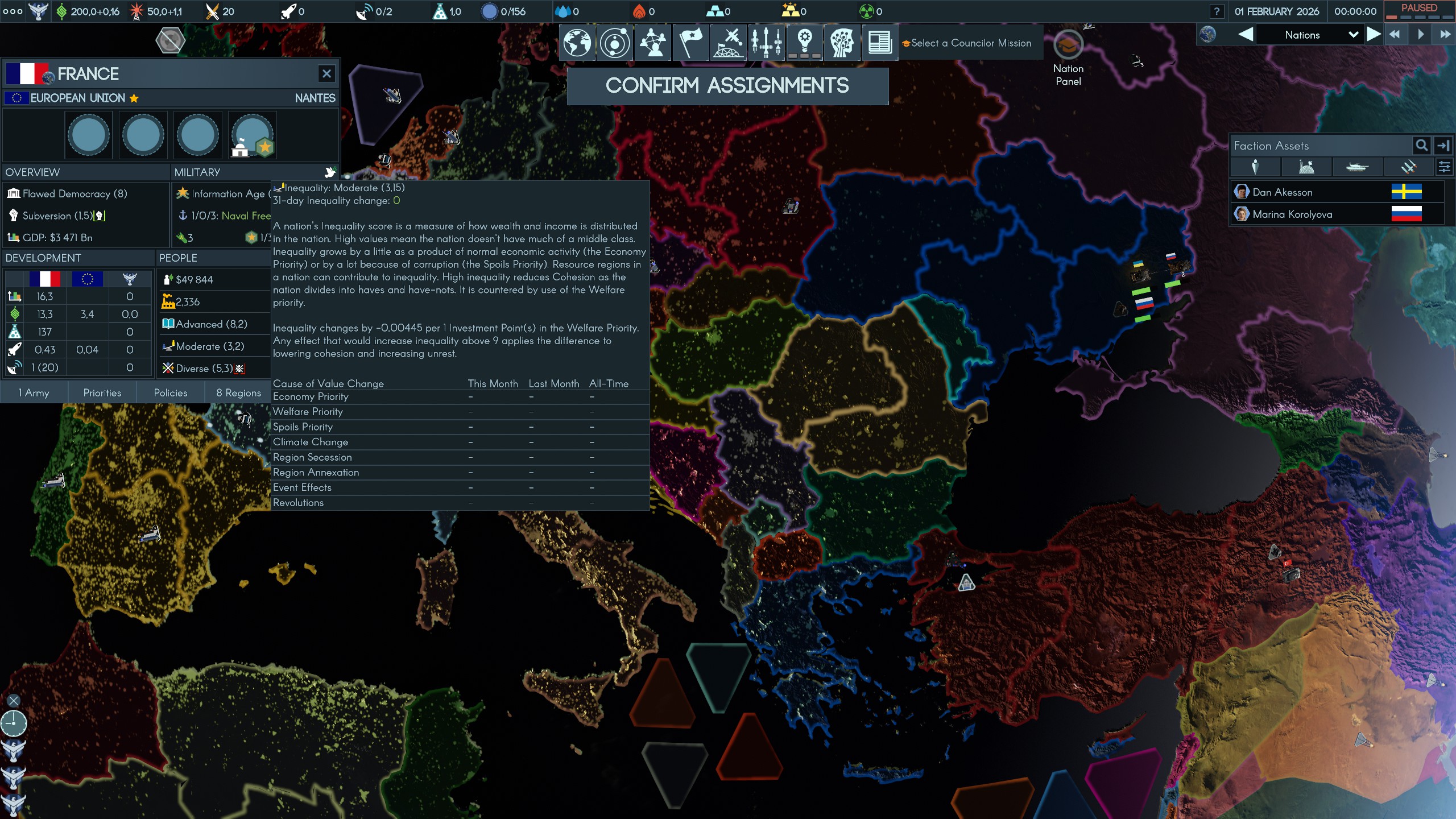
In Terra Invicta you don't control nations directly. You start out as one of 8 factions with completely different goals. One faction wants to ally with the aliens, another wants to exterminate them, a third one just wants to leave earth and so on. You have to influence nations to get some control of them and benefit from their resources. Eventually you'll get into space and start building space stations (stations such as the ISS already exist btw). More stable, or large nations are more difficult to gain control over, so you have to make short and long term decisions on what nations you want. You could take control of smaller, or less stable nations to quickly get access to their resources or maybe try to build them up, or you could try to gain control of ones that already have a space program. Since you eventually want to get to space, and the game uses some real world physics, you'll also have to consider what regions are suitable for space programs (near the equator is better overall). You'll quickly realize how much this game tries to simulate. Every nation on earth has one or more control points with GDP and other information based on current real world data. It doesn't stop there, once you look at the solar system, you'll realize that the game doesn't only have the planets, but also larger asteroids and moons to colonize, or build orbital stations around.
With eight factions that all play differently, combined with a tech tree that deliberately locks certain projects to specific playthroughs, there's a lot of replayability here. I haven't tried all the factions yet. In fact, I've only played two of them.
Agents & Organizations
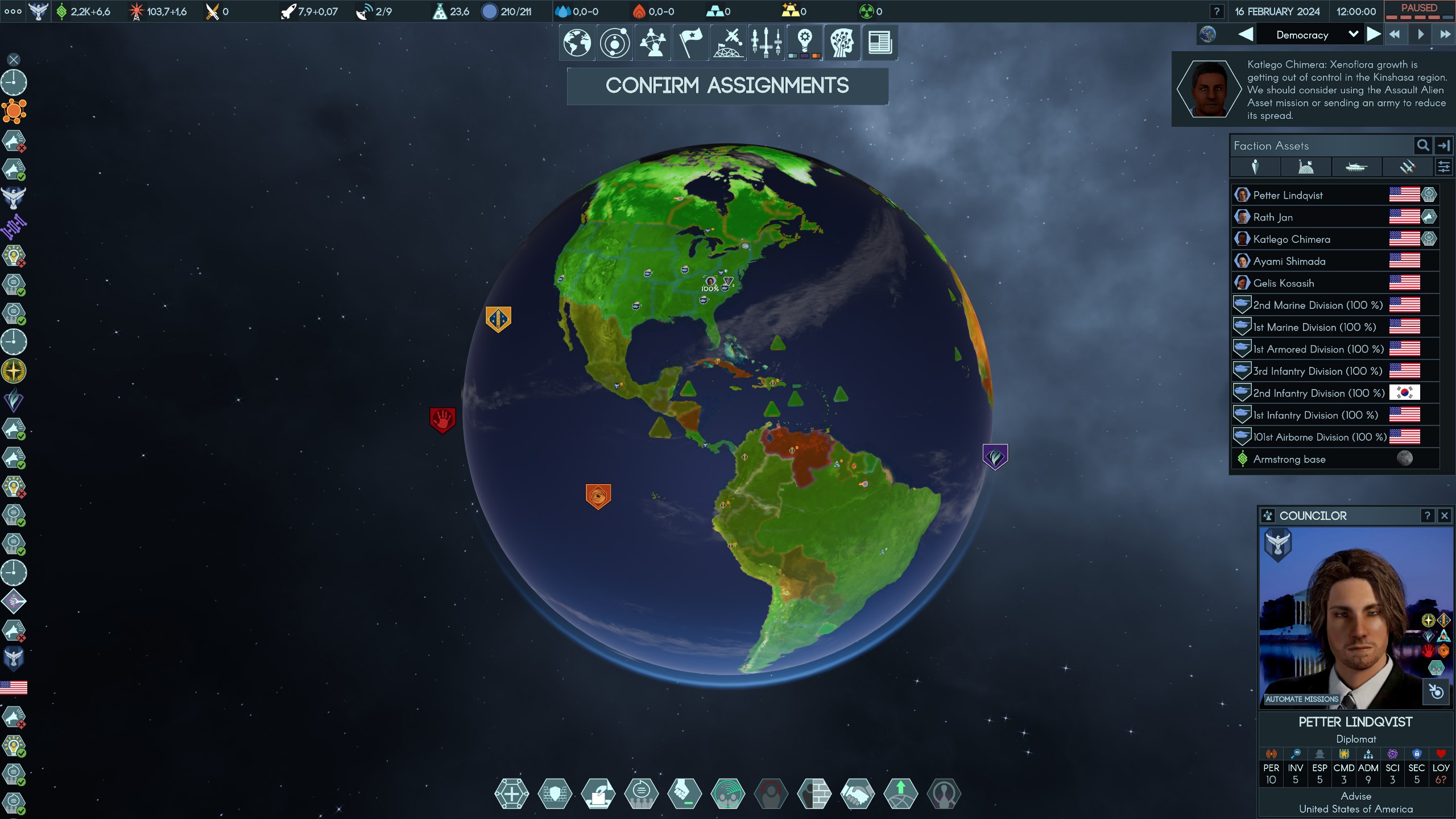
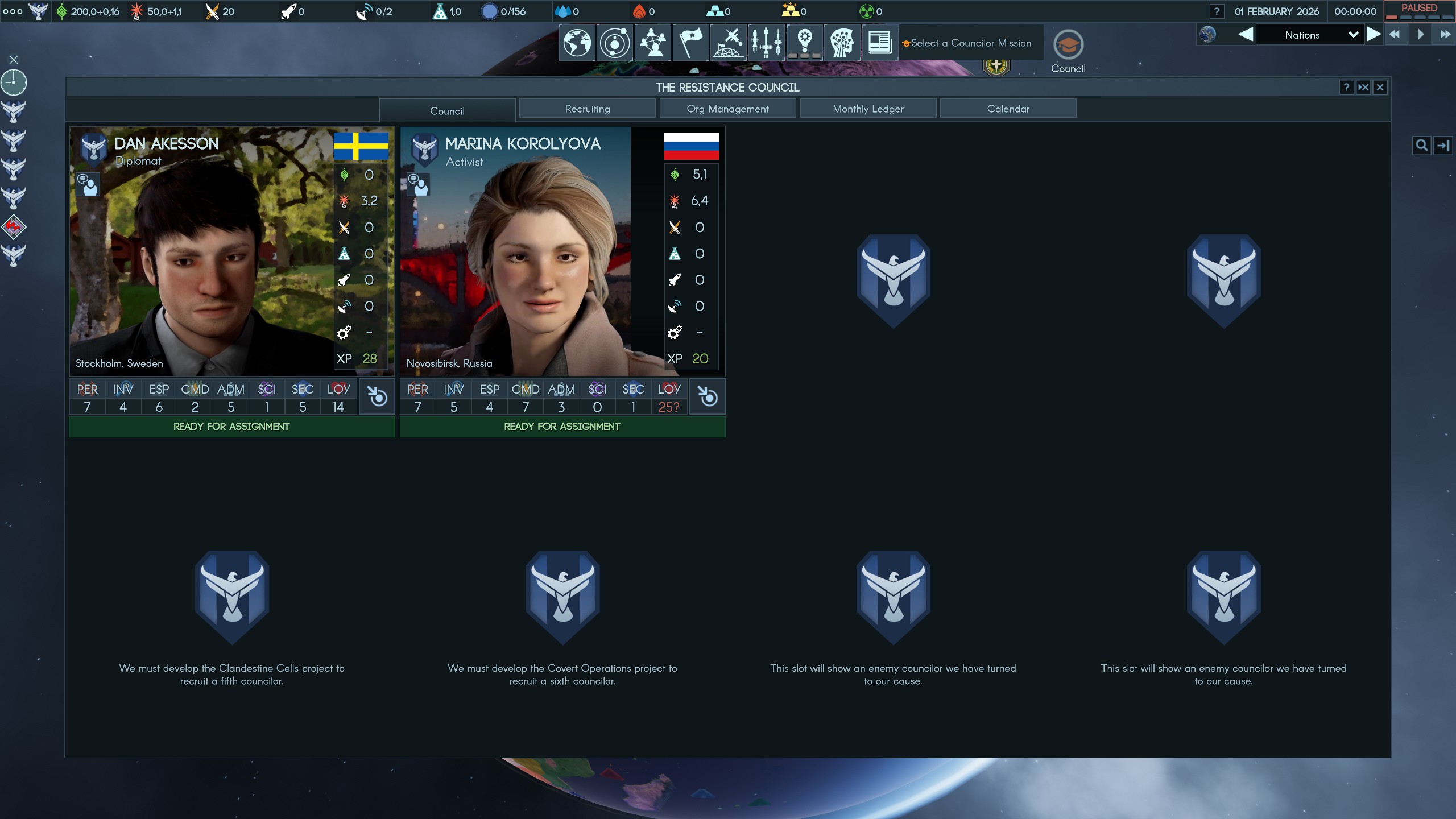
You interact with nations, assets and other factions by using agents. The agent system is quite complex with different agent classes, traits and stats to determine what skills they can use. Agents are used for everything from taking control of nations to assassinating or detaining agents from other factions. You start the game with two agents but can recruit more as the game progresses.
The agent system, like a lot in this game, is quite deep and complex. For example an agent can give you bonuses to influence in countries where education is below a certain threshold, or only give benefits in certain countries, so you really have to think about how and where you use your agents.
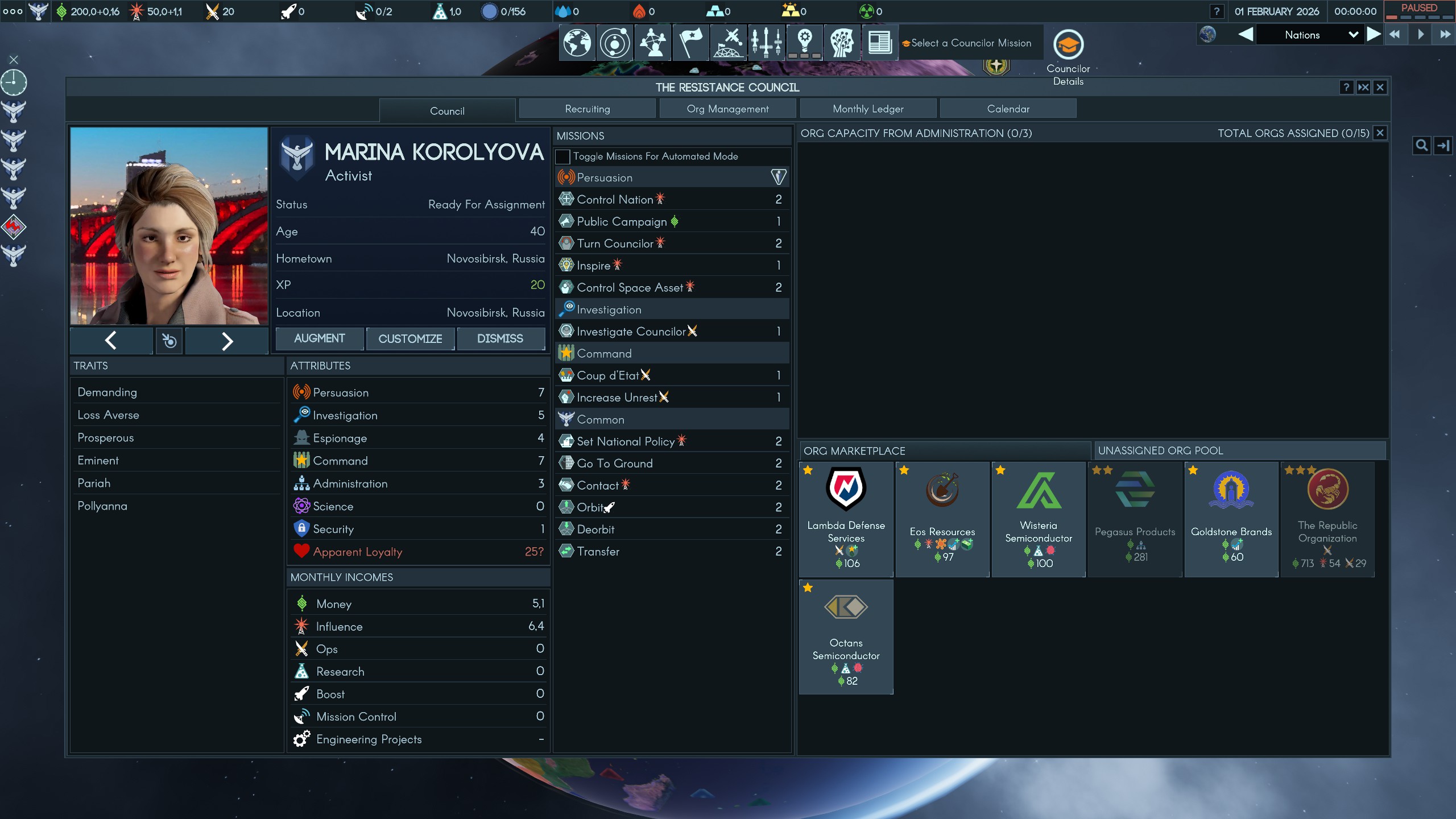
The game also has organizations which you can use depending on what nations and agents you control. A lot of these are real world organizations such as intelligence agencies, military organizations, companies and criminal organizations (SAS and MI5 if you control the UK for example). Organizations will give you all sorts of bonuses and sometimes drawbacks in different areas.
Research
The research system is a great part of this game. There is public research which will benefit everyone. You have some influence over what public projects get picked. Once a public project is completed you'll get access to private engineering projects which only your faction will benefit from. This means you'll have to be careful what public projects you support to achieve your goals. The tech tree is the largest I've ever seen in a game, but you can't, and you don't need to research everything. Some projects only have a certain chance to unlock for your faction in a playthrough, so you'll not always have access to all the projects you want. Having said that, there is always alternatives, and there's a lot of technologies you don't need. The game has lots of rocket engines for example, but you'll only need one, or a few of them. There are also a lot of earth related techs to unify nations, or how to deal with the aliens.
Earth Phase: Geopolitics & Threats
You'll get your first alien contact right at the start of the game, but for the most part the aliens don't have a huge effect on the game early on. The aliens are not your only threat however, especially not early on. Humanity is far from united in this game. Each faction has their own goal, and nations on earth can and will fight each other. This can include an all out nuclear war, which I haven't seen in my own game yet.
Space
I haven't got far enough into the post-release game to give a full account of this section. I'll update the review when I have.
Once you get into space and start establishing colonies (this will take a while), you'll eventually start building a space fleet. The game has a ship designer and real time space battles. It seems very comprehensive. Real world physics are also simulated, which means that transfer windows between celestial bodies matter. It'll sure matter when it comes to how long it'll take you to travel around the solar system.
Terra Invicta is a mix of turn based and real time. You make weekly, biweekly or monthly decisions where the game pauses, but you progress time in real time. Space battles are real time, but can be paused as well. You can either have cinematic battles where you don't have to consider fuel usage, or you can use real world physics, in which case you have to consider fuel usage during battles to avoid having your fleets end up on an escape trajectory where you end up on a course that prevents you from going back home.
UI & Learning Curve
Some will argue that the UI and learning curve are the weakest parts of this game, and I must admit, it's very overwhelming at first. The game has so much information and so many things affecting each other, it can be difficult to find the things you're looking for. I still don't want to call it bad, even though recent Paradox titles have better UI. Same with the learning curve, you won't see your mistakes right away, it will take years before you realize you're in a death spiral, but you can also turn things around. Just don't expect to start the game and know everything right away. There is a tutorial now, but it will only point you in the right direction early on. Since information is interconnected and scattered all over the place, the UI could really benefit from a nested tooltip system.
Conclusion
I haven't played this game enough to draw a final conclusion, but I think it's safe to say it's a good game. If you want an extremely complex and ambitious game that tries to do a lot of things, you should like this. Whether or not it succeeds is up to you to decide, but I think it does a really good job, especially considering the size of the development team. If you like grand strategy games, hard sci-fi and some 4x elements, this game could be for you.